We may earn a commission from Booking.com, Expedia, GetYourGuide, DiscoverCars, Airalo, Saily and Samsonite links; it never changes a ranking. How rankings and funding work.
Best time to visit the Maldives, month by month
The best time to visit the Maldives is January to March, when the northeast monsoon brings the driest, sunniest weather and sea visibility above 30 metres. February averages 38mm of rain. For manta rays, go July to September in Baa Atoll.
Best single month: February. Best value: late April or June. Best for mantas: July to September. The best time to visit the Maldives is January to March, when the northeast monsoon brings the driest, sunniest weather. February averages just 38mm of rain across three wet days. April is the hottest month. May to November is the wetter southwest monsoon, when resort rates typically fall 30 to 50 percent and manta season peaks in Baa Atoll.
This guide contains affiliate links. We may earn a commission when you book, at no extra cost to you.
Best months
Jan to Mar
Driest
Feb, 38mm
Wettest
Oct, 245mm
Sea
28 to 30°C
Cheapest
Sep and Jun
Last updated
October 2026
When Is the Best Time to Visit the Maldives?
Quick answer
The best time to visit the Maldives is January to March, when the northeast monsoon brings the driest, sunniest weather. February averages just 38mm of rain across three wet days. April is the hottest month. May to November is the wetter southwest monsoon, when resort rates typically fall 30 to 50 percent and manta season peaks in Baa Atoll.
Key takeaways
Best weather: January to March. February is the driest month.
Hottest month: April, with highs near 32°C and a 30°C sea.
Wettest month: October, with about 245mm of rain over 15 days.
Cheapest months: September and June.
Manta rays: May to November in Baa Atoll, peaking July to September.
Whale sharks: all year round in South Ari Atoll.
The Maldives sits almost on the equator, so it's warm every month of the year, with highs between 30 and 32°C and a sea that never drops below 28°C. What changes is the rain, the wind and the price. Get the timing right and you can trade a little cloud for a much lower rate, or swim with manta rays you'd never see in the dry season.
Maldives Weather by Month
These are the official 1991 to 2020 averages for Malé, which is a good guide for the central atolls. Sea temperatures are long term averages.
Maldives weather by month (Malé, 1991 to 2020 averages)
Air temperature, rain, rain days and sunshine: World Meteorological Organization 1991 to 2020 normals for Malé, as published by the Maldives Meteorological Service. Sea temperature: Weather2Travel long term averages.
Rain and sunshine by month
87
Jan8.3h
Driest38
Feb9.3h
49
Mar9.3h
127
Apr8.7h
238
May7.2h
146
Jun7.0h
198
Jul6.9h
193
Aug7.4h
214
Sep6.9h
Wettest245
Oct7.4h
236
Nov6.8h
212
Dec6.9h
Rainfall in mm with daily sunshine hours. Lower bars mean drier months.
Maldives Seasons: Dry, Wet and Shoulder
The Maldives has two monsoons rather than summer and winter. Locals call the dry northeast monsoon Iruvai and the wet southwest monsoon Halhangu. April and December are transition months, which travel companies usually sell as shoulder season.
Dry season (January to March)
Clear skies, calm seas and the best visibility on the eastern side of the atolls.
Good for: honeymoons, first visits, snorkelling, photography.
Watch out for: the highest rates of the year and villas selling out early.
Shoulder season (April and December)
Mostly good weather with prices starting to move.
Good for: late April value, early December deals.
Watch out for: April heat and humidity, and the festive price jump from about 20 December.
Wet season (May to November)
More cloud, wind and heavy showers, but still around seven hours of sun a day.
Good for: low prices, manta rays, surfing.
Watch out for: choppier boat transfers, occasional seaplane delays, and May and October being the wettest.
JanFebMarAprMayJunJulAugSepOctNovDecWeatherDryDryDryChangeWetWetWetWetWetWetWetChangePricesPeakPeakPeakHighLowLowLowLowLowestLowShoulderShoulder then peakMantas (Baa)YesYesPeakPeakPeakYesYesWhale sharks (South Ari)YesYesYesYesYesYesYesYesYesYesYesYesSurfYesYesYesPeakPeakYesYesYes
Dry season runs January to March, the wet southwest monsoon May to November, with April and December in between. Mantas peak July to September; whale sharks stay all year.
The Best Month for Every Kind of Trip
Driest weather
February
38mm of rain and over nine hours of sun a day.
Honeymoon
February or March
The fewest rain days and the calmest seas.
Snorkelling
March
Flat water and clear visibility on the house reefs.
January is peak season and it feels like it. The northeast monsoon brings dry air, calm seas and over eight hours of sunshine a day, with only five or six wet days in the month. Rates stay at their highest until around 6 January, when the festive crowds head home and prices ease a little. Snorkelling visibility on the eastern side of the atolls is excellent.
February is the driest month of the year, with just 38mm of rain across about three wet days and more than nine hours of sunshine daily. It's the safest bet for blue skies, which is exactly why honeymooners love it. Chinese New Year falls on 6 February 2027, so that week is busy and expensive. Book well ahead.
March is the sunniest month, matching February at over nine hours of sun a day, and the sea warms to around 29°C. Easter Sunday is 28 March in 2027, which pushes prices up in the second half of the month. Ramadan runs from roughly 8 February to 9 March 2027. Resorts operate as normal and most guests won't notice a difference.
April is the hottest month, with highs near 32°C and the warmest sea of the year at about 30°C. It's a transition month, so rain rises to around 127mm over eight or nine days, usually as short afternoon showers. Once the Easter break is over, rates start to ease, which makes late April one of the best value windows of the year.
May is when the southwest monsoon arrives, and it's the second wettest month at around 238mm. Expect more cloud, wind and heavy bursts of rain, though seven hours of sunshine a day is still typical. The upside is price. Rates drop into low season, and manta season begins in Baa Atoll.
June is wet but surprisingly good value. Rainfall falls back to around 146mm, rates are among the lowest of the year and resorts often throw in free nights or transfers. Surfers love it too, as June and July bring the biggest swells. If you want an overwater villa for less, this is a smart month to look.
July brings highs of about 31°C, around 198mm of rain over 14 days and nearly seven hours of sunshine a day. A typical week mixes several clear days with a few afternoon storms. Manta gatherings at Hanifaru Bay build towards their peak. Independence Day on 26 July is a national holiday.
August has low season weather with a mid month price spike, as Italian and other European families arrive for the Ferragosto holiday around 15 August. Rain averages 193mm over 13 days. It's one of the best months for mantas in Baa Atoll, and resorts with kids' clubs and slide villas get busy.
September is usually the cheapest month of the year. It's wet, with about 214mm of rain over 15 days, but the sea stays at 28°C and the sun still shines for nearly seven hours a day. Manta season is in full swing. If price matters more than perfect skies, this is the month to book.
October is the wettest month, averaging 245mm over 15 days. The showers are heavy but usually pass within an hour or two. Prices stay low apart from Chinese Golden Week, 1 to 7 October. Mantas are still around in Baa Atoll, though the biggest gatherings are usually over.
November is the tail end of the wet season, with around 236mm of rain and the least sunshine of the year at about 6.8 hours a day. Conditions improve as the month goes on, and shoulder season rates make it fair value. Republic Day on 11 November is a public holiday.
December is a transition month, with around 212mm of rain over 12 days as the dry northeast monsoon returns. Early December is good value. From around 20 December, minimum stays, compulsory gala dinners and festive rates make the next two weeks the most expensive time of the whole year.
The Cheapest Time to Visit the Maldives
September and June are usually the cheapest months, followed by the rest of the May to October low season. Resort rates are typically 30 to 50 percent below the January to March peak, and many resorts add free nights, upgrades or transfers on top. The most expensive stretch is from about 20 December to 6 January, when minimum stays and compulsory gala dinners apply.
JanPeak
FebPeak
MarPeak
AprHigh
MayLow
JunLow
JulLow
AugLowMid month spike
SepLowest
OctLow
NovShoulder
DecEarlyShoulder
DecLatePeak
PeakHighShoulderLow
Whatever month you pick, remember the extras. Most resorts add a 10% service charge, then the 17% Tourism GST, plus a green tax of $12 per person per night. Our guide to the cheapest Maldives overwater villas works out the real cost per night.
Hanifaru Bay in Baa Atoll, a UNESCO Biosphere Reserve, is the most famous manta site in the Maldives. The season runs from May to November, with the biggest feeding gatherings usually between July and September. It's snorkel only, capped at 80 people a day for 45 minutes in the water, with a $30 entry fee. Book a resort in Baa Atoll to get there easily.
Whale shark season
South Ari Atoll is one of very few places on earth where whale sharks can be seen all year round. Most sightings are along the outer reef of the South Ari Marine Protected Area, and resorts such as Conrad Maldives Rangali Island and Villa Park sit close by.
Surf season
The surf season runs from March to October, with the biggest and most consistent swells in June and July. North and South Malé Atolls have the best known breaks.
Holidays That Push Prices Up in 2027
Dates that affect Maldives prices in 2027
When
What
Effect on prices
20 Dec 2026 to 6 Jan 2027
Christmas and New Year
The most expensive weeks of the year
6 Feb 2027
Chinese New Year
Busy week, rates rise
Around 8 Feb to 9 Mar 2027
Ramadan
Resorts run as normal, little effect
28 Mar 2027
Easter Sunday
Late March rates rise
26 Jul 2027
Independence Day
Public holiday, little effect on resorts
Around 15 Aug 2027
Ferragosto, Italian summer holiday
Mid August spike
1 to 7 Oct 2027
Chinese Golden Week
Busy week in low season
11 Nov 2027
Republic Day
Public holiday, little effect on resorts
20 Dec 2027 onwards
Festive season
Minimum stays and gala dinners return
Which Atoll Suits Which Month?
Two simple rules help. First, rainfall rises from north to south: the northern atolls average about 1,779mm a year and the southern atolls about 2,218mm, so the north is a touch drier overall. Second, visibility follows the wind. From December to April the clearest water is usually on the eastern side of an atoll, and from May to November it switches to the western side, where the manta and plankton action is.
Tropical cyclones are extremely rare because the islands sit so close to the equator. The far northern atolls can occasionally feel the edge of an Arabian Sea storm between August and November.
Resorts to Book by Season
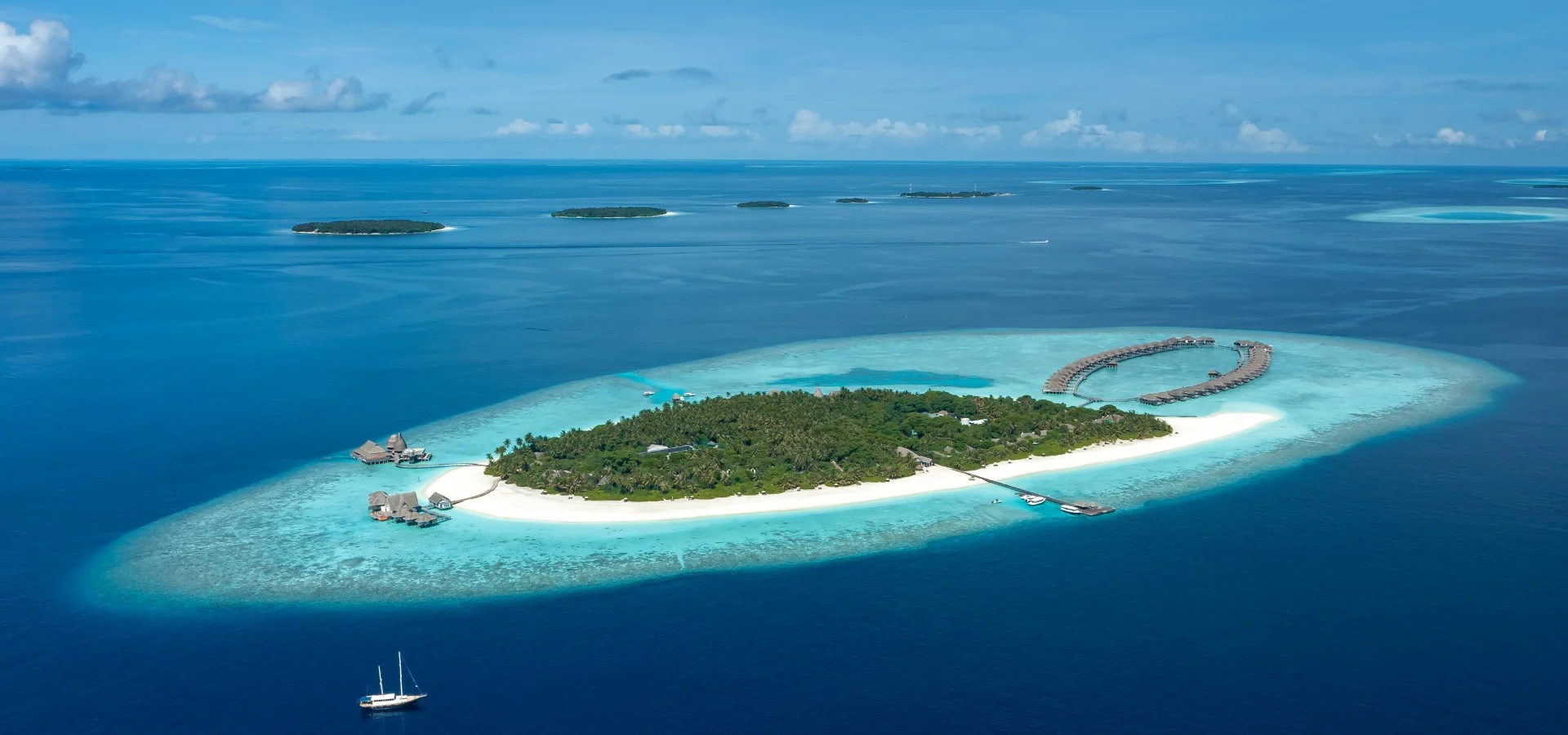
Soneva Jani
Noonu Atoll
Photo: Soneva Jani, official resort photography
1 / 5
Photo: Soneva Jani
Setting
Noonu Atoll
Transfer
40 min seaplane
Best months
January to April, when Noonu's lagoon is at its calmest.
The benchmark Maldives resort for the peak weather window.
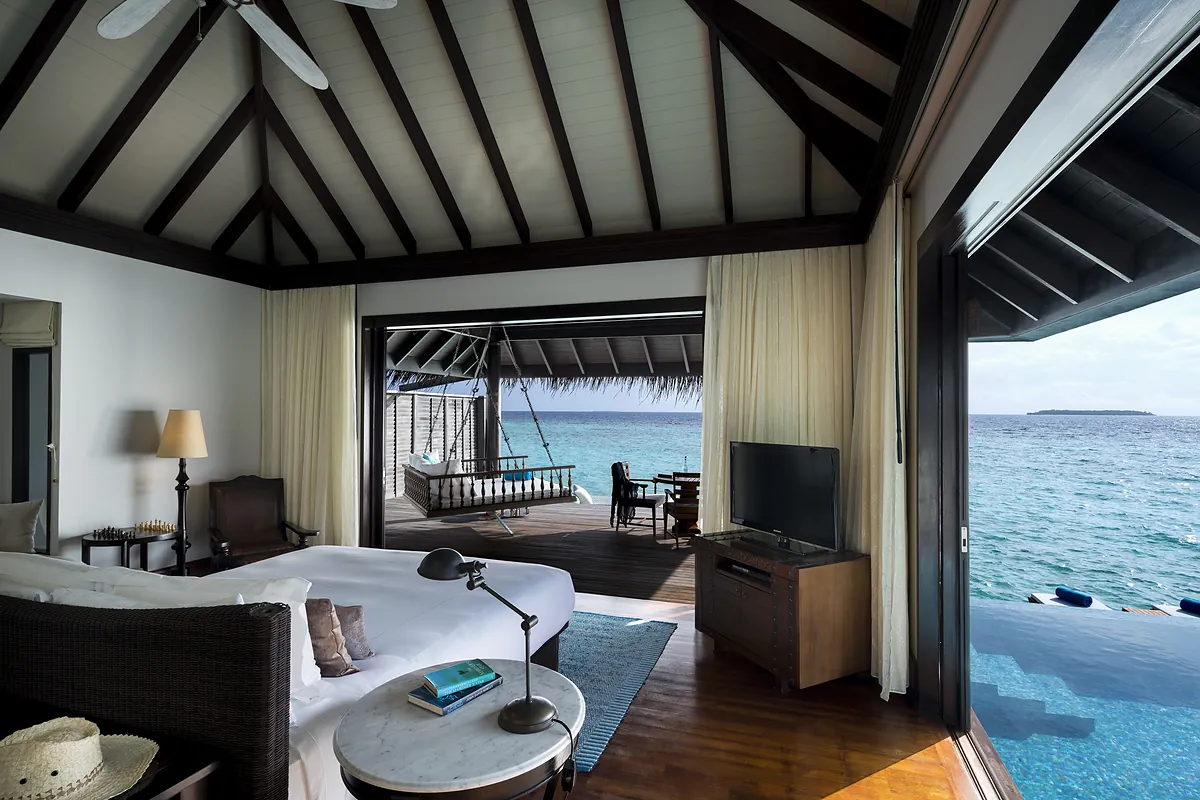
Retractable villa roofs and observatory experiences are unmatched on a clear night, which is most nights between January and April.
The honest drawback
The seaplane transfer runs only in daylight, so a late flight can mean an airport overnight.
Best months: any month, as whale sharks are around all year.
Getting to the Maldives from the UK and US
Every international flight lands at Velana International Airport on Hulhulé, next to Malé. From the UK, nonstop flights from London take around 10 hours, and one stop routes through Dubai, Doha, Abu Dhabi or Istanbul take around 13 to 16 hours. There are no nonstop flights from the US, so most travellers connect through the Gulf or Istanbul, which takes roughly 20 to 24 hours from the East Coast. Book seaplane transfers to land before dark, as seaplanes only fly in daylight.
Tips for Timing Your Trip
Book peak season eight to twelve months ahead. The best overwater villa categories can sell out early for Christmas, February and Easter.
Try late April or early December. These transition windows offer lower rates, but neither comes with a promise of dry weather.
Check the festive extras. From around 20 December, minimum stays and compulsory gala dinners can change the total substantially.
Choose Baa Atoll for mantas. July to September gives the best chance of the biggest Hanifaru Bay gatherings.
Match visibility to the wind. Favour the eastern side of the atolls from December to April and the western side from May to November.
Book a flexible rate. Read the cancellation terms and leave enough daylight for your seaplane transfer.
Air temperature, rainfall, rain days and sunshine are World Meteorological Organization 1991 to 2020 averages for Malé, published by the Maldives Meteorological Service. Sea temperatures are long term averages from Weather2Travel. Wildlife seasons come from the Maldives Whale Shark Research Programme and Baa Atoll's Hanifaru Bay management rules. Price levels reflect typical resort rate patterns and change every year, so always check live rates. We don't accept payment for placement. Read our full methodology.
So, When Should You Go?
For the best weather, go in February or March. For the best value with mostly dry weather, aim for late April or early December. If you want manta rays, book Baa Atoll between July and September, and if a lower price matters more than perfect skies, September is hard to beat.
January to March brings the most sunshine and least rain, with February averaging just 38mm. April is hotter and still mostly dry. For value, May to October brings lower rates and the best manta season.
September and June are usually cheapest, both in the southwest monsoon low season. Resorts often add free nights or transfers. Avoid mid August, when European holidays lift prices.
October, averaging 245mm over 15 days, closely followed by May and November. Rain usually falls in heavy showers that clear within an hour or two.
No. The islands sit almost on the equator, where tropical cyclones are extremely rare. The far northern atolls occasionally feel the edge of an Arabian Sea storm between August and November.
Hanifaru Bay in Baa Atoll runs from May to November, with the biggest gatherings usually July to September. The bay is snorkel only, capped at 80 people a day, with a $30 entry fee.
All year round in the South Ari Marine Protected Area, one of very few year round whale shark sites on earth. Conrad Maldives Rangali Island and Villa Park both sit close by.
Yes, for travellers who value price and marine life over guaranteed sun. Malé still averages around seven hours of sunshine a day from May to November, and the sea stays at 28 to 30°C.
Highs of about 31°C, around 198mm of rain over 14 days and nearly seven hours of daily sunshine. A ten night stay typically mixes several clear days with a few afternoon storms.
April, with average highs of 31.9°C and the warmest sea of the year at around 30°C. Humidity climbs as the dry season ends.
It is a transition month, averaging 212mm of rain over 12 days. Early December is good value, but from around 20 December minimum stays and gala dinners make it the priciest time of year.
February and March, with the fewest rain days and over nine hours of daily sunshine. Late April and June suit couples watching the budget.
Eight to twelve months ahead for Christmas, February and Easter, as the best overwater villas sell out first. Three to six months is usually enough from May to October.
Find Your Maldives Dates
Compare live prices for your month across hundreds of Maldives resorts through Booking.com.
This article contains affiliate links. If you book a hotel through our links we may earn a small commission at no extra cost to you. It does not change what we recommend.
All guides are desk research from maker specifications, operator policies and published rates, with sources and available check dates listed on this page.
Sources and reading dates (0)
No source URL was recoverable from this page’s existing data. A source ledger is needed.
A complete source ledger is still needed for this guide. Unknown reading dates are not treated as new checks.